
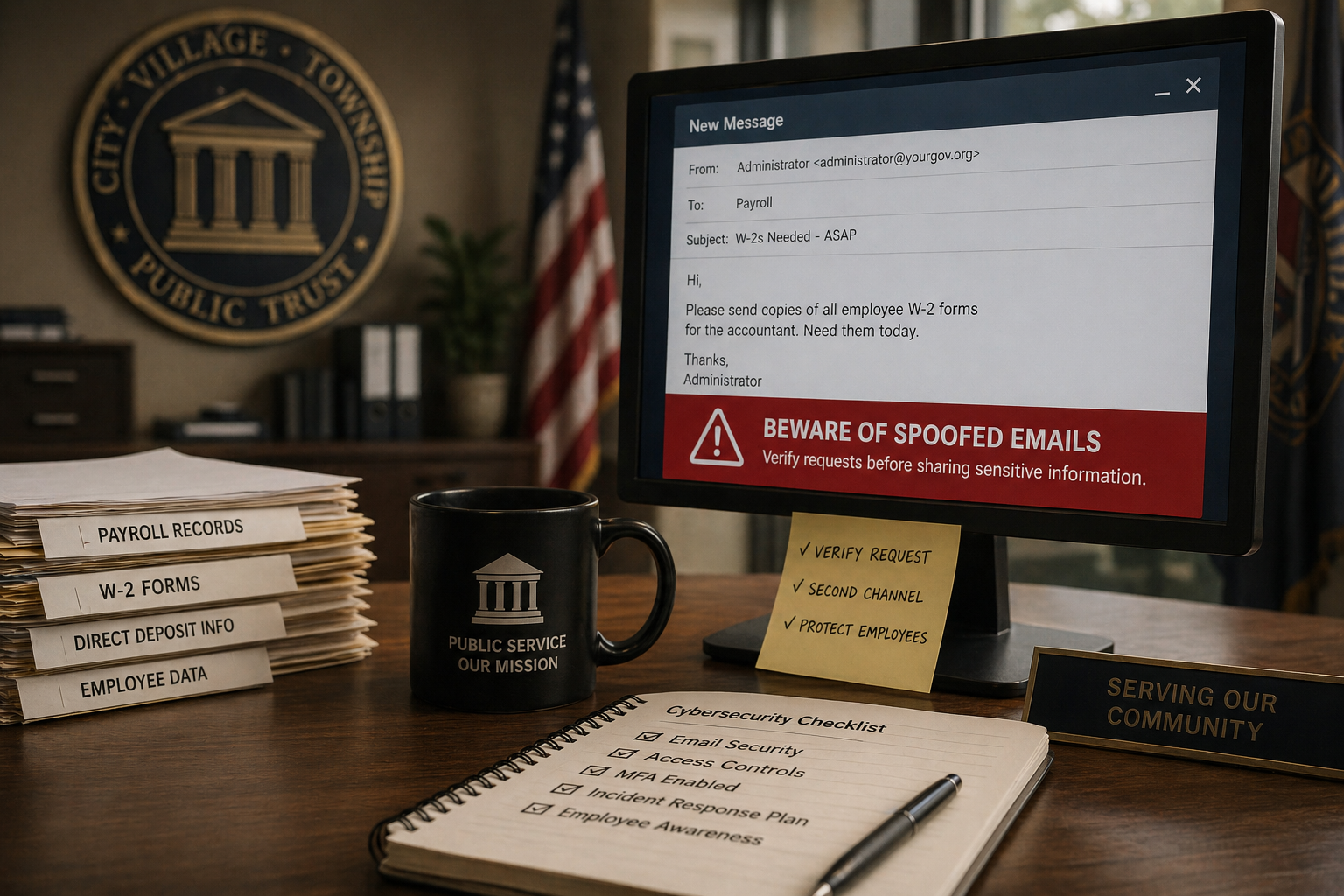
Most local government offices do not think of payroll season as a cybersecurity issue. It usually just feels like a seasonal rush—the finance team processing more approvals than normal, payroll pushing through deadlines, HR pulling together records on a compressed timeline.
That is exactly the environment where a payroll scam works best
The Scam Looks Like Normal Work
A finance clerk receives what appears to be a quick email from the administrator, finance director, or another trusted leader. The message asks for employee tax documents, a direct deposit change approval, or W-2 information. The wording is short, urgent, and believable because that is how real internal requests sound when everyone is busy and deadlines are tight.
The request looks normal enough to move forward.
If the employee responds without stopping to verify it, sensitive information—Social Security numbers, home addresses, pay information, personnel details—can leave the agency before anyone realizes the request was fake. For a municipal office, that creates immediate problems: privacy exposure, potential fraud, legal questions, and a public trust issue. If the request turns into an actual incident, what happens in the first 24 hours matters just as much as how the mistake occurred.
For a municipal office, that creates immediate problems: privacy exposure, potential fraud, legal questions, and a public trust issue if the mistake becomes known.
Why This Works: Pressure Turns Security Into a Judgment Call
The scam succeeds not because the request is sophisticated. It succeeds because a believable message arrives during a time when the office is under deadline pressure, and the person receiving it has no required verification step to fall back on.
So the employee faces a judgment call: Should I trust this email, or should I slow things down to double-check?
Under deadline pressure, most people choose to move the request forward. That is not carelessness. That is how offices actually work.
The problem is that the security decision becomes the employee’s responsibility alone, in the moment, with incomplete information.
The Real Protection: Build Verification Into the Workflow
The stronger approach does not ask employees to be more suspicious. It builds a simple verification rule into the process before the request arrives.
Here is what that looks like:
Employee tax records, direct deposit changes, and sensitive payroll information should never be sent based only on an email request.
Instead, the rule is: Anything involving employee data or payment changes requires verification through a separate trusted channel before the information moves.
That separate channel could be:
- A known phone number to the person who supposedly made the request
- A direct conversation, not email
- An established workflow or approval form that requires in-person or separate confirmation
- Any verification step that happens outside the original email thread
The key is that the verification step exists before anyone has to guess whether to trust the email.
What Changes When Verification Is Built In
When a verification rule is in place and known to staff:
- The employee does not carry the security decision alone. The rule is clear. The request requires verification. That is not the employee being cautious; that is how the process works.
- Leadership reinforces it. When a director or supervisor sends a real payroll request and gets asked to verify it through a separate channel, they say yes and move on. That signal matters. It tells staff that verification is normal, expected, and not an insult to leadership.
- The fake request fails quietly. An attacker sends a spoofed email asking for employee data. The employee follows the rule: verification required. The attacker cannot verify through the separate channel because they are not actually the person they are pretending to be. The request stops there.
- The office keeps moving. Real work still happens on schedule. The difference is that the security step is built into the workflow, not added as an extra burden.
Why Judgment Calls Under Pressure Are the Vulnerability
Most payroll scams do not ask for something outrageous. They ask for something that sounds reasonable during a busy time: W-2s, updated payroll records, a direct deposit change, employee contact information. The request does not feel suspicious because it is not that different from normal requests that actually do come through during payroll season.
That is why awareness campaigns alone do not work well. Telling employees to “be more suspicious” asks them to carry too much risk during the exact moment when they feel pressure to keep work moving.
But a simple rule—verification required for sensitive payroll requests—shifts the burden from the employee’s judgment to the process itself.
A process is more reliable than a judgment call made under pressure.
Verification Also Protects Leadership
There is another advantage that is often overlooked: a verification requirement also protects leadership.
If an employee receives a request that appears to come from the finance director and sends sensitive data without verifying, the employee may be blamed. But the real failure is that the office had no process to catch it.
When a verification rule exists and is consistently followed, leadership has a clearer record of how the office is expected to handle sensitive requests and where the breakdown occurred
That matters when leadership is asked to prove what was in place during insurance reviews, legal inquiries, or public accountability questions.
How to Start
The first step is simple: decide which payroll and finance requests require verification, and make that decision clear to staff.
Examples:
- Direct deposit changes
- Employee tax records (W-2s, 1099s, tax withholding info)
- Payroll reports or personnel files
- Vendor payment changes
For each one, establish what verification looks like: a phone call to a known number, an in-person conversation, a separate confirmation step, or an established approval form.
Write it down. Share it. Have leadership reinforce it, especially during payroll season.
Then, when a request comes in that requires verification, the employee knows exactly what to do. No judgment call. No guessing. Just follow the rule.
The Question Leadership Should Ask
The better question is not whether payroll scams exist.
It is this: Do staff have a clear, supported verification step for sensitive payroll requests, or are they still making judgment calls under deadline pressure?
If they are still relying on judgment alone, the problem is bigger than the email itself. It is a process problem. And that is something leadership can fix before the next request arrives.
Questions Leaders Are Asking
Why do payroll scams work so well against local government offices?
The scam succeeds not because the request is sophisticated. It succeeds because a believable message arrives during a time when the office is under deadline pressure, and the person receiving it has no required verification step to fall back on. So the employee faces a judgment call: Should I trust this email, or should I slow things down to double-check?
What does a payroll scam email typically look like in a municipal office?
A finance clerk receives what appears to be a quick email from the administrator, finance director, or another trusted leader. The message asks for employee tax documents, a direct deposit change approval, or W-2 information. The wording is short, urgent, and believable because that is how real internal requests sound when everyone is busy and deadlines are tight.
How should local governments protect against payroll scams without slowing down operations?
Employee tax records, direct deposit changes, and sensitive payroll information should never be sent based only on an email request. Instead, the rule is: Anything involving employee data or payment changes requires verification through a separate trusted channel before the information moves. Real work still happens on schedule. The difference is that the security step is built into the workflow, not added as an extra burden.
Which payroll and finance requests should require verification in a local government office?
Direct deposit changes, employee tax records (W-2s, 1099s, tax withholding info), payroll reports or personnel files, and vendor payment changes. For each one, establish what verification looks like: a phone call to a known number, an in-person conversation, a separate confirmation step, or an established approval form.
Why don't cybersecurity awareness campaigns alone stop payroll scams?
Telling employees to 'be more suspicious' asks them to carry too much risk during the exact moment when they feel pressure to keep work moving. But a simple rule—verification required for sensitive payroll requests—shifts the burden from the employee's judgment to the process itself. A process is more reliable than a judgment call made under pressure.