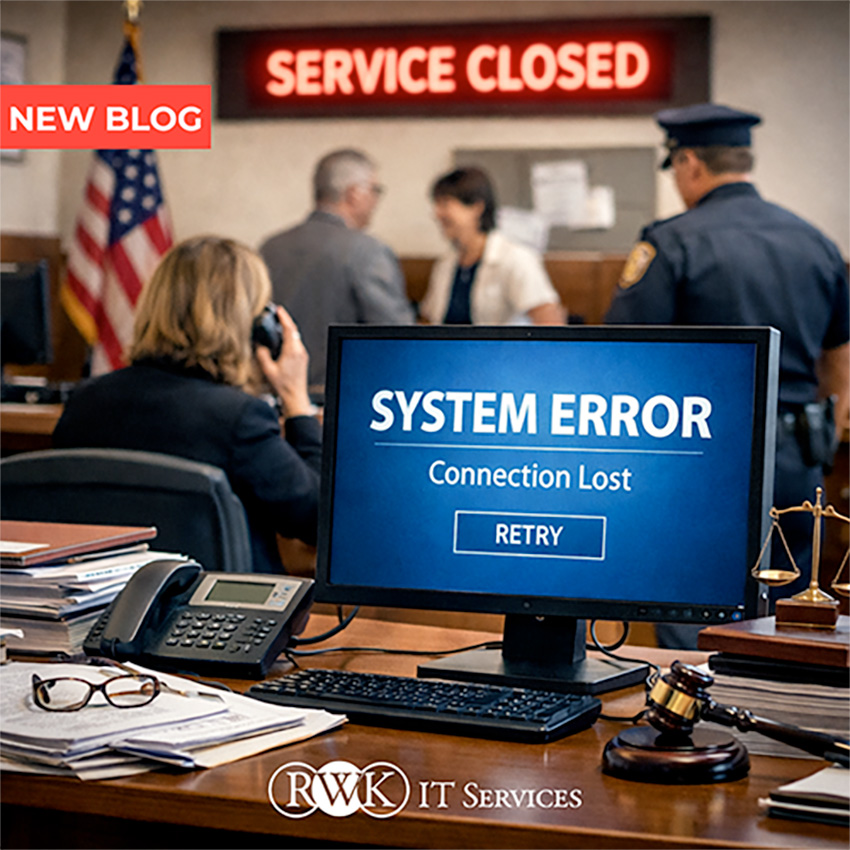
There’s a special kind of silence inside a village hall or township office in Frankfort, Joliet, Orland Park, Bolingbrook, or Plainfield when a critical system stops responding.
Not the “it’s lunch” quiet. Not the “everyone’s in a meeting” quiet.
It’s the quiet where someone clicks Refresh one more time, then looks up and says:
“Is it just me… or is the system not loading?”
Maybe it’s CAMA.
Maybe it’s tax billing or the online payment portal.
Maybe it’s finance, payroll, clerk recording, file services, or the email inbox that runs half your workflows.
Whatever it is, when it goes down, it doesn’t feel like “IT.”
It feels like government stops working.
In the Chicago suburbs, that downtime doesn’t stay internal for long. Residents notice. Departments stall. Elected officials get questions. The public wants answers - fast.
In 2026, the biggest IT risk for municipalities and local agencies isn’t “bad technology.” It’s fragile operations, systems that technically run, until the day they don’t.
That’s why forward-thinking local governments across the Chicago suburban corridor (including Will County communities like Joliet, Plainfield, Bolingbrook, Orland Park, and Frankfort) are moving away from one-off “security projects” and toward something more practical:
Resilience
Resilience means your municipality can keep serving the public, even when something breaks, fails, gets locked, or gets hit.
Request a Resilience Review
https://rwksolvesit.com/contact-us/
Why Chicago Suburb Local Governments Are in the Blast Zone (and It’s Not Personal)
To attackers, and honestly, to time and entropy, local government can look like a perfect target:
- High pressure, high visibility: residents, media, FOIA, elected officials
- Hard deadlines: tax cycles, payroll, elections, budget season, appeals windows
- Complex environments: many vendors, many integrations, many “don’t touch it” systems
- Data that’s painful to recreate: records, parcel history, financial transactions, emails
- Limited redundancy: a few key people, a few key systems, and a tight window to recover
When an incident hits in Frankfort, Joliet, Orland Park, Bolingbrook, Plainfield, or any Chicago suburb municipality, the cost isn’t only dollars.
It’s time, trust, and credibility, and those are harder to rebuild than a server.
The New Standard: Resilience Over “Perfect Security”
You will never be “done” with cybersecurity.
But you can be resilient.
That means you plan for:
- a vendor outage
- a failed update
- a compromised password
- ransomware that targets backups
- an aging server that finally gives up at the worst possible time
Resilience doesn’t start with shiny tools. It starts with three non-negotiables, things leaders can understand, fund, and measure.
The 3 Non-Negotiables Smart Chicago Suburb Governments Are Prioritizing Right Now
1) Backups That Restore (Not Just Backups That Exist)
A nightly backup is comforting. A backup you’ve tested is survival.
Resilient governments do three things differently:
- They test restores on a schedule (not “when we have time”)
- They keep offline/immutable backups so attackers can’t encrypt or delete them
- They define recovery in human terms, not tech terms, like:
- “If finance is down at 9am Monday, when can we cut checks again?”
- “If payroll goes down, what’s the manual process, and who owns it?”
- “If CAMA/GIS is down, what work continues and what stops?”
Plain-English takeaway: If you’ve never tested a restore, you don’t have a backup. You have a hope.
If you want to sanity-check your recovery approach, start by reviewing what “Backup & Disaster Recovery” should look like in real municipal environments, then compare it to your current restore testing cadence:
Backup & Disaster Recovery: https://rwksolvesit.com/it-support-government-nonprofit/
2) “Zero Trust” Habits (Without Turning City Hall Into Fort Knox)
Ignore the buzzword. Focus on the behavior:
- Staff don’t have more access than they need
- Admin accounts are rare and locked down
- Multi-factor authentication (MFA) is standard for remote access and privileged accounts
- Patching and monitoring happen before problems become emergencies
- Logs and alerts turn into action, not unread notifications
This isn’t about distrusting staff.
It’s about accepting reality:
Passwords get stolen. People click things. Vendors get compromised.
Resilient municipalities in the Chicago suburbs assume something will slip, and they limit the blast radius.
Plain-English takeaway: Your best defense is limiting how far a single mistake can spread.
If your MFA coverage is inconsistent (especially for admin accounts and remote tools), start here:
Managed Security Services: https://rwksolvesit.com/managed-security/
3) A Simple Governance Framework Leaders Can Actually Use
The biggest reason IT budgets get stuck isn’t always money.
It’s that leadership doesn’t have a shared language to prioritize risk.
That’s why governance frameworks like NIST CSF 2.0 matter, especially because they help leadership treat cyber risk like operational risk.
You don’t need more “paperwork.” You need a way to answer:
- What matters most?
- What breaks service delivery?
- What do we fix first?
- What are we knowingly accepting as risk?
Plain-English takeaway: Frameworks aren’t red tape. They’re how you explain why you’re funding restore testing instead of another “tool.”
Modernization in Local Government: Cloud, Hybrid, or “Don’t Touch It”?
Here’s the quiet truth inside a lot of local governments in the Chicago suburbs:
Some systems can’t be safely “left alone” anymore. Not because they’re bad systems, but because the environment around them is brittle:
- aging servers
- patching gaps
- no true disaster recovery
- unclear vendor responsibility (“Wait… who patches that?”)
- key knowledge stuck in one person’s head
- integrations that were never documented and can’t be quickly rebuilt
Cloud isn’t magic. The best outcomes come from planning that starts with continuity, not trends.
Hybrid Resilience First (the approach that wins)
For many municipalities in Frankfort, Joliet, Orland Park, Bolingbrook, and Plainfield, the practical path looks like this:
- Stabilize what must stay on-prem (critical LOB apps, on-site dependencies)
- Move what benefits from faster recovery (email/collab, backups, some portals, some GIS workloads)
- Standardize identity/access so security doesn’t become a patchwork quilt
- Document ownership so vendors can’t point fingers mid-incident
If you’re looking for a clean, structured way to operationalize this (without turning it into a “big rewrite”), your Managed IT Services foundation matters:
Managed IT Services: https://rwksolvesit.com/managed-it-services/
Local government work is seasonal. Your systems don’t need peak horsepower every day, but they do need reliability when the calendar says so.
What This Means for Boards, Administrators, and Elected Officials in the Chicago Suburbs
Resilience is not “an IT project.”
It’s a service guarantee.
The strongest leadership teams do three things consistently:
Demand clarity
- “What are our top 10 systems, and who owns each vendor relationship?”
- “What breaks if it goes down, and what’s our recovery plan?”
Fund the unsexy essentials
- restore testing
- MFA
- patching
- monitoring
- incident response planning
- vendor accountability
Define what risk you’re accepting
If you choose not to invest in resilience, that isn’t “saving money.” It’s accepting downtime, whether anyone says it out loud or not.
The 5 Questions That Prevent Panic Later (Save This)
Use these in a department head meeting, committee meeting, or budget workshop in Joliet, Frankfort, Orland Park, Bolingbrook, Plainfield, or anywhere across the Chicago suburbs:
- If email or the network goes down Monday morning, what still works?
- When did we last test a full restore of a real business process, not just a server?
- Do we have MFA on remote access and privileged/admin accounts everywhere?
- Can we prove who changed what (audit trail) in sensitive systems and records?
- Who is responsible, on paper, for patching, monitoring, and after-hours response?
If any answers are fuzzy, that’s not failure.
That’s your roadmap.
Want a plain-English “Top 10 Systems & Recovery Readiness” scorecard for your municipality?
We’ll review backup restorability, access controls, vendor ownership, and recovery steps, then deliver a short, leadership-ready summary.
Get the Scorecard: https://rwksolvesit.com/contact-us/
The Bottom Line for Local Government IT in Chicago’s Suburbs
Local governments don’t get applause when technology works. You only hear about it when it doesn’t.
That’s why the most effective municipalities in the Chicago suburbs and Will County region are shifting from “IT projects” to IT resilience:
- tested recovery
- sensible access controls
- clear ownership
- modernization that reduces risk instead of adding it
Because public service can’t afford IT to be a wildcard.
Frequently Asked Questions About Local Government IT Resilience in the Chicago Suburbs
What does “IT resilience” mean for local governments in the Chicago suburbs?
In the Chicago suburbs, IT resilience means your municipality can keep serving residents even during outages, ransomware incidents, or vendor failures. It focuses on tested restores, clear ownership, and access controls that prevent one mistake from taking down multiple systems. For most local governments in places like Joliet, Plainfield, and Orland Park, resilience is less about buying new tools and more about proving recovery works under pressure.
How often should a municipality in Illinois test backup restores?
Many Illinois municipalities back up nightly, but resilience comes from scheduled restore testing, at least quarterly for critical systems and more often during peak seasons like budget, tax cycles, or elections. In Chicago suburb environments with multiple vendors, testing also confirms who is responsible for what during recovery. If you haven’t tested a restore recently, you don’t really know your recovery time.
What are the most common causes of IT downtime for local governments near Joliet, IL?
For municipalities near Joliet, downtime often comes from failed updates, aging server hardware, vendor outages, compromised accounts, and misconfigured backups, not just “hackers.” Complex integrations and unclear patching responsibility can turn a small issue into a multi-day disruption. Resilience planning reduces the blast radius and speeds recovery when something fails.
Do small villages in places like Frankfort or Orland Park need Zero Trust and MFA?
Yes, especially in Frankfort, Orland Park, and similar Chicago suburbs where staff wear multiple hats and remote access is common. MFA on email, VPN, remote tools, and admin accounts dramatically reduces account takeover risk. Zero Trust doesn’t have to be disruptive; it can start with least-privilege access, MFA, and tighter controls around privileged accounts.
How much does a resilience-focused IT program cost in the Chicago suburbs?
Costs vary based on system count, vendor complexity, and whether you need modernization, but most Chicago suburb municipalities see resilience as a mix of operational improvements (testing, documentation, monitoring) plus targeted upgrades (backup immutability, MFA, identity standardization). The most important step is defining recovery goals in plain English, then funding the specific controls required to meet them.
Can you improve recovery readiness without moving everything to the cloud?
Absolutely. Many Chicago suburb local governments take a hybrid approach: stabilize what must stay on-prem, move what improves recovery (like email/collaboration and backup strategy), and standardize identity and access. Cloud isn’t the goal, continuity is. A practical hybrid plan can reduce downtime risk without forcing a disruptive migration.
What should we bring to a resilience review for our municipality in Plainfield or Bolingbrook?
For a Plainfield or Bolingbrook resilience review, bring a list of your top systems (CAMA/GIS, finance, payroll, email, file services), your backup method and last restore test date, your remote access/MFA status, and vendor contact ownership. The goal is a leadership-ready snapshot: what breaks first, how fast you can restore, and what you’d fix to be “Monday morning ready.”
If you’d like a no-fluff resilience review (backups, access, vendor ownership, recovery readiness) designed specifically for local government operations in the Chicago suburbs, contact us, and we’ll show you what “Monday morning ready” looks like.
Schedule a Resilience Review https://rwksolvesit.com/contact-us/
If you want a practical, plain-English incident readiness resource to align leadership and IT before the next “oh no” moment, reference:
The Cyber Playbook: https://rwksolvesit.com/cyber-playbook/