Why third-party systems and software providers can disrupt operations faster than most leaders expect
Most teams rely on vendors more than they realize.
When those systems are working, no one thinks about them. When they are not, things slow down or stop almost immediately.
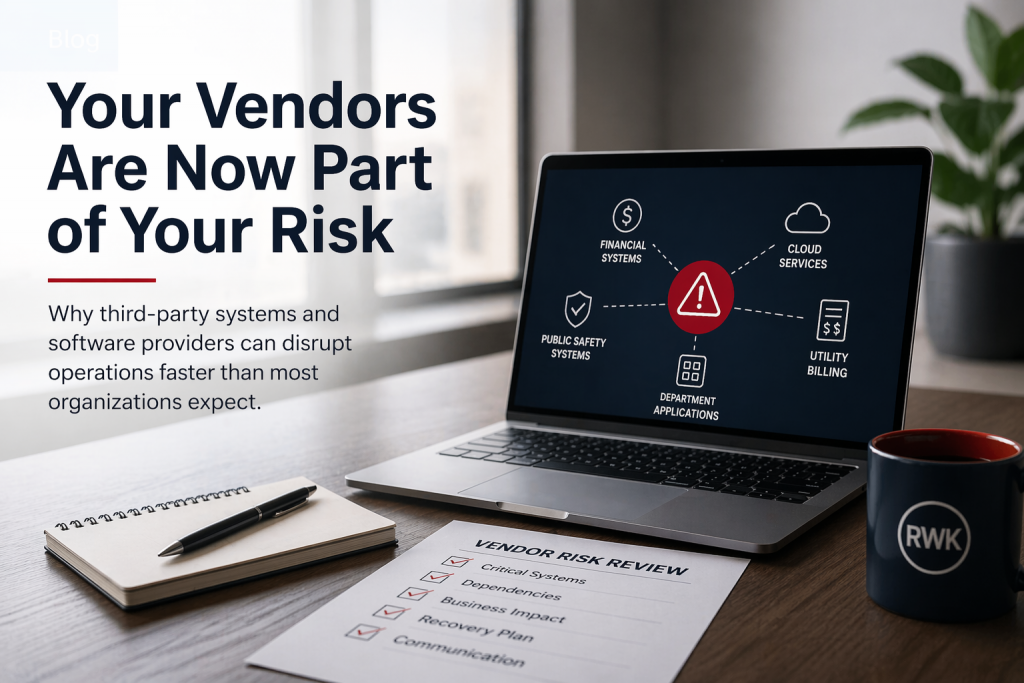
Financial platforms. Utility billing systems. Dispatch and public safety tools. Microsoft 365. Department-specific applications that staff use every day without much thought.
These systems are essential to day-to-day operations. At the same time, they sit outside of your direct control.
That is where the risk begins.
What Is Vendor Risk in IT and Operations?
Vendor risk refers to the operational, security, and continuity exposure created by relying on third-party systems, software providers, and external platforms to run critical functions.
In simple terms, if a vendor system becomes unavailable, your team may not be able to operate normally until that system is restored.
When a Vendor Goes Down, So Do Your Operations
When something internal breaks, there is usually a path forward. Someone owns it. Someone can start working the issue.
When a vendor system goes down, the situation changes.
You are waiting for updates.
You are dependent on their timeline.
You do not control how quickly things move.
And in many cases, no one can give you a clear answer on how long recovery will take.
In municipal environments, we have seen this affect:
- Police and fire reporting systems
- Utility billing and payment processing
- Permitting and inspection workflows
- Financial operations and payroll
- Resident-facing services
In other environments, the systems may be different, but the impact is the same. Work slows down or stops, and leadership is left answering questions that depend on someone else.
Often, there is no clear timeline and no ability to influence how quickly things get resolved.
The Assumption That Creates Risk
There is a common assumption that rarely gets challenged:
“If the vendor is solid, we are fine.”
That holds up right until it does not.
Vendors experience outages.
They get hit with ransomware.
Infrastructure fails.
Recovery takes longer than expected.
Even when systems come back online, internal teams still need to re-establish normal operations.
The real issue is not whether the vendor recovers.
It is what happens while you are waiting.
What We See in Real Environments
In many environments we review, vendor dependencies are not formally documented or tied to continuity planning, even though daily work relies heavily on them.
When disruption happens, the pattern is familiar.
The problem is rarely the provider itself. More often, the dependency was never fully thought through.
Teams do not always have a clear view of which systems are truly critical, how long they can function without them, or what a fallback process should look like.
Communication is another gap. Who is coordinating with the vendor? Who is updating leadership? How are departments expected to operate in the meantime?
These questions tend to get answered in real time, which slows response and increases disruption.
This is not a vendor issue.
It is a control and planning issue.
Why Vendor Risk Is Increasing
Vendor risk is growing because reliance on cloud platforms, external providers, and integrated systems continues to expand.
As more processes depend on these tools, the impact of an outage becomes immediate and more widespread.
At the same time, visibility into how these systems are secured, monitored, and restored is often limited.
That combination creates exposure that many teams do not fully see until something breaks.
How This Escalates Quickly
Once a vendor issue starts affecting operations, it moves quickly.
Departments cannot perform their normal work.
Staff begin creating workarounds.
Residents or customers experience delays.
Leadership looks for answers and timelines.
For municipalities and public sector teams across Illinois and the Chicago suburbs, this often affects essential services and requires fast decisions with limited information.
At that point, the questions shift:
How long will this last?
What is our backup plan?
Can we continue operating?
Who is coordinating the response?
These are not technical questions. They are operational decisions.
The challenge is that the answers depend on something outside of your control.
Where This Shows Up With Insurance and Accountability
Cyber insurance has started to reflect this reality.
Applications and renewals now include more questions about vendor relationships, third-party access, and operational dependencies.
If an incident involves a provider, teams may be asked to show how that risk was evaluated and what planning existed ahead of time.
This shifts vendor management beyond procurement.
It becomes part of risk management and accountability.
What Actually Reduces Vendor Risk
The teams that handle this well are not eliminating vendors. That is not realistic.
They are putting structure around how those dependencies are managed.
They identify critical systems and understand how long operations can continue without them. They define fallback processes, even if those processes are not perfect.
They establish clear ownership for vendor coordination and internal communication during an issue.
They also understand what data is controlled externally and whether it can be recovered independently if needed.
This is where continuity planning and vendor oversight connect.
The difference is not the vendor.
It is whether there are structured controls in place to manage the dependency.
The Shift That Needs to Happen
Many teams still evaluate vendors based on functionality and cost.
That made sense when systems were more isolated.
Today, those same tools are deeply embedded in daily operations.
Vendors are no longer just service providers. They are part of your operational risk.
The better question is no longer:
“Is this a good vendor?”
It is:
“What happens to us if this system is unavailable for a day?”
Or longer.
The Big Takeaway
Vendor risk is not theoretical. It shows up in very practical ways.
If a critical system becomes unavailable, the impact is immediate.
The teams that navigate this well are not the ones with the most technology.
They are the ones that understand their dependencies, define their response, and avoid trying to figure everything out in the middle of an issue.
Because when a vendor problem happens, the real question is not:
“What is the vendor doing to fix it?”
It is:
“How prepared are we to operate without it?”
Closing
If your operations depend on systems that are critical to daily work, it is worth understanding how those dependencies are managed before a disruption forces the issue.
RWK IT Services works with municipalities, public sector teams, and businesses throughout Illinois, the Chicago suburbs, and Northwest Indiana to help identify operational dependencies, reduce vendor-related risk, and build structured approaches to continuity, recovery, and accountability.